
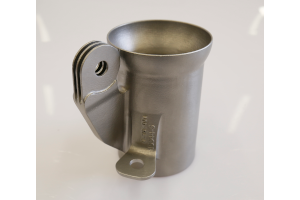
Aerokurier, one of Germany’s leading aviation magazines, has reported on the recent EASA STC (Supplemental Type Certificate) for a 3D-printed exhaust part. In fact, this marks a significant achievement in the field of certified additive manufacturing for aviation applications. Therefore, it represents an important step toward wider acceptance of advanced production technologies in regulated industries.
First fully 3D-printed exhaust component
The certified part is a lightweight and high-performance exhaust section developed for gliders and light aircraft. Furthermore, by using industrial metal 3D printing, the design achieves weight savings and improved thermal performance. As mandated, by regulation, the part has been tested and validated according to EASA standards, resulting in an official STC approval. As result, this makes it one of the first fully 3D-printed exhaust components to receive such certification in Europe.
Moreover, Aerokurier’s coverage emphasizes the technological leap and regulatory significance of this development. Additionally, as additive manufacturing continues to mature, certified components like this demonstrate how 3D printing can meet stringent aviation safety standards. In addition, the report also highlights the role of innovative engineering and close cooperation with regulatory authorities.
At VOCUS, we are proud to contribute to this advancement. The development of the 3D-printed exhaust part reflects our commitment to lightweight, efficient, and certified aerospace solutions.
Above all, the EASA STC for this 3D-printed part is more than just a technical achievement — it’s a step toward the future of aerospace manufacturing.
Additive manufacturing in certified aviation applications
This project demonstrates how additive manufacturing has evolved beyond prototyping. Previously, regulatory bodies were hesitant to approve critical aircraft parts made with emerging technologies such as metal 3D printing. However, recent advances in process control, material testing, and post-processing have paved the way for certified applications. Consequently, the successful approval of this component sets a precedent for future certified parts.
In conclusion, the achievement shows that innovation and certification can go hand in hand—even in conservative, safety-driven industries like aerospace.